
Early detection of bark beetle infestation using UAV-borne multispectral imagery: a case study on the spruce forest in the Czech Republic
 Tomáš Klouček
 Roman Modlinger
 Markéta Zikmundová1,3
  Marlena Kycko
 Jan Komárek
- 1Department of Spatial Sciences, Faculty of Environmental Sciences, Czech University of Life Sciences Prague, Prague, Czechia
- 2Forest Risk Research Centre, Faculty of Forestry and Wood Sciences, Czech University of Life Sciences Prague, Prague, Czechia
- 3Department of Mathematics, Informatics and Cybernetics, Faculty of Chemical Engineering, University of Chemistry and Technology Prague, Prague, Czechia
- 4Department of Geoinformatics, Cartography and Remote Sensing, Faculty of Geography and Regional Studies, University of Warsaw, Warsaw, Poland
Abstract
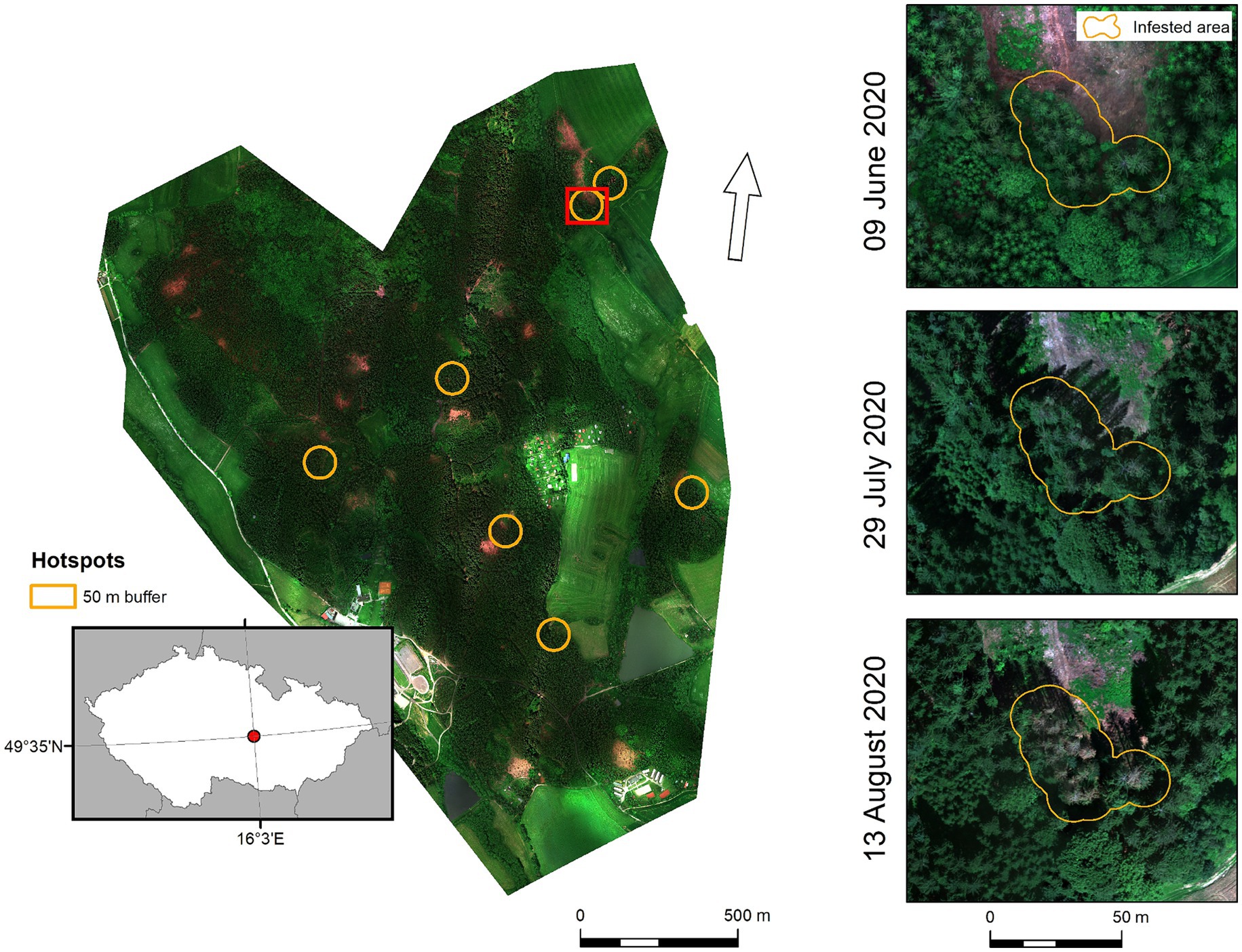
Over the last decade, biotic disturbances caused by bark beetles have represented a serious environmental and economic issue in Central Europe. Great efforts are expended on the early detection and management of bark beetle infestation. Our study analyses a time series of UAV-borne multispectral imagery of a 250-ha forest in the Vysočina region in the Czech Republic. The study site represents a typical European spruce forest with routine silvicultural management. UAV-borne data was acquired three times during the vegetation period, specifically (a) before swarming, (b) at the early stage of infestation, and (c) in the post-abandon phase, i.e., after most bark beetle offspring left the trees. The spectral reflectance values and vegetation indices calculated from orthorectified and radiometrically calibrated imageries were statistically analyzed by quadratic discriminant analysis (QDA). The study shows that healthy and infested trees could be distinguished at the early stage of infestation, especially using NIR-related vegetation indices (NDVI and BNDVI in our case). Detecting infested trees is more significant by vegetation indices than spectral bands and increases with the increasing time after infestation. The study verified the usability of UAV-borne multispectral imageries for early detection of bark beetle infestation at the level of individual trees. Thus, these methods can contribute to precise and effective forest management on a local level.
https://www.frontiersin.org/articles/10.3389/ffgc.2024.1215734/full